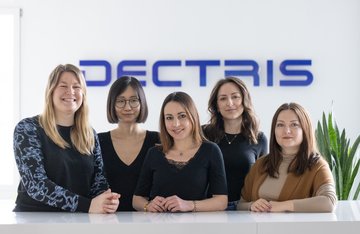
Highlights & Impressions from IUCr 2026
Among the highlights at the IUCr 2026 were DECTRIS JUNGFRAU launch, an Exhibition and Scientific Contributions, a DECTRIS Party, and lots of fun times!
Stay up-to-date with DECTRIS development, product updates, and featured users.
Highlights & Impressions from IUCr 2026
Among the highlights at the IUCr 2026 were DECTRIS JUNGFRAU launch, an Exhibition and Scientific Contributions, a DECTRIS Party, and lots of fun times!
Extending the POLLUX Family: Introducing POLLUX PANORAMA HR
How far can you push resolution in a 2D detector without sacrificing versatility and overall performance in laboratory XRD? That question led us to the newest member of the POLLUX family: POLLUX PANORAMA HR. Launched at EPDIC 2026, our high-resolution detector combines a pixel pitch of just 37.5 µm along the long axis of the detector with the flexibility of a 2D pixel detector, opening new possibilities for high-resolution laboratory XRD.
Cockroach milk research earns 2026 Ig Nobel Prize in Chemistry
Sometimes the most unexpected scientific discoveries can lead to the most memorable stories. Ramaswamy Subramanian, a professor in Purdue University’s Department of Biological Sciences; Leonard “Leo” Chavas, structural biologist and general manager and representative director of DECTRIS Japan; and Nathan Coussens, director of the In Vitro Evaluation and Molecular Pharmacology Laboratories at the Frederick National Laboratory for Cancer Research, received the 2026 Ig Nobel Prize in Chemistry for their research into how a species of cockroach nourishes its developing embryos.
Achieving the Highest Resolution Protein Structure Through Advanced X-Ray Diffraction Techniques
Through Advanced X-Ray Diffraction Techniques , researchers have determined the structure of the protein rubredoxin at 0.43 Ångström resolution, marking the highest resolution ever achieved for a protein structure.
DECTRIS CLOUD Is Now DECTRIS D.LAB: Extending The Mission From Capturing The World's Finest Data To Preserving The Scientific Knowledge That Follows. On its 20th anniversary, DECTRIS extends its mission further, from detecting the invisible to transforming it into the understandable with a platform designed to connect data, analyses, compute, and scientific context into one home for modern research.
Modern Macromolecular crystallography (MX) relies on a foundation of trusted, highly optimized software to translate raw diffraction images into meaningful structural biology insights. For decades, XDS - the software program developed by Wolfgang Kabsch - has served as a critical component in this workflow. Max Planck Innovation and Wolfgang Kabsch have chosen to entrust DECTRIS with the long-term stewardship, distribution, and support of XDS through an exclusive licensing agreement. Through this transition, DECTRIS ensures that (a) XDS remains freely available to academic researchers without
Versatility Meets Performance: DECTRIS POLLUX on Idonano XRD instruments
On May 19, 2026, we traveled to China to meet our OEM partner IDONANO, a pioneer in China's domestic high-end XRD market. During this visit, we held a workshop giving detailed insights into the features, advantages, and benefits of POLLUX detectors. Following the workshop, we commissioned a prototype and performed the first successful tests of the new POLLUX detector on IDONANO’s laboratory XRD systems. POLLUX is an important milestone in our partnership and will unlock unprecedented performance on IDONANO’s instruments to address emerging challenges in materials science, semiconductor metrolo
DECTRIS Japan Announces Leadership Transition: Leonard Chavas Appointed as Representative Director
HIMEJI, JAPAN | April 2026 – DECTRIS Japan K.K., a subsidiary of the global leader in Hybrid Photon Counting (HPC) detector technology, DECTRIS Ltd., today announces a change in its executive leadership. Dr. Takeyoshi Taguchi has stepped down as Representative Director, with Dr. Leonard Chavas appointed as his successor to lead the company into its next phase of growth.
White Paper: Advancing Scattering Experiments with Hybrid Photon Counting Detectors
This white paper explores how DECTRIS’s Hybrid Photon Counting detectors enhance SAXS and WAXS experiments, enabling high-resolution, low-noise data collection in both synchrotron and laboratory environments.
Chemical Reactivity Visualised
A 10-minute read Figure 1: Artist view of partial charges of histidine. Illustration reproduced with kind permission of Jessica Freivoltová. Conferences are valuable sources of inspiration for scientists. Latest results are presented, celebrated, or challenged. Poster sessions, coffee breaks, and conference dinners create a vibrant atmosphere, where novel hypotheses are formed, and in the best cases, seed the idea for important, new developments. But inspiration is not enough, as we all know. Method development is tedious and requires a favourable mixture of expertise, perseverance, and frustr
Powering the Future of Fast X-ray 3D CT Battery Imaging: New Joint Publication with Excillum
DECTRIS and Excillum have published a joint article demonstrating how combining high-brightness MetalJet X-ray sources with fast, sensitive photon-counting detectors enables rapid, high-quality 3D CT imaging for battery inspection. The study highlights significant image-quality improvements, faster defect detection, and synchrotron-like performance in laboratory and production settings, underlining the partners’ commitment to advancing next-generation X-ray technology.
High-Energy PXRD Experiments Empowered by the PILATUS4 CdTe Detector
We are proud to share that our article—“Enhancing high‑energy powder X‑ray diffraction applications using a PILATUS4 CdTe detector” (Donath et al. J. Synchr. Rad. 2025, 32, 378) has been published. This study was conducted in collaboration with scientists at the MAX IV Laboratory (Sweden) and the European Synchrotron Radiation Facility (ESRF, France). Using the new PILATUS4 CdTe detector, we pushed the limits of resolution, speed, and performance in high-energy PXRD.